
3 things I wish I knew about Purdue academics as a freshman

As a popular Paramore song promises it will be “fun, living in the real world.”
But — while being fun, college is still hard. Here are three things about academics I wish I was told before my first year at Purdue.
#1 You’re on your own kid
I know it’s cliché but you will get out of college what you get into it. My brother has this great line about college.
“You can have a relaxing four years and a very hard rest of your life. Or you can focus, put in the effort for four years, and have an easier rest of your life.”
While initially only telling my brother, “yeah I get it” to get him off my back, in my first year at the Old Gold and Black I can now say I get where he is coming from.
You have to come face to face with the fact that not every teacher is here for your education. Some are here mainly due to research and you may have to put in extra effort to ensure you are learning.
The structure of learning is entirely different from high school but some study strategies from the K-12 era may still work for you: for instance, group studying. Finding someone in each of your classes will make you a stronger academic weapon, forcing you to wake up and go to that 7:30 a.m. lectures. With study buddies you can stay and keep others accountable, whether that is just making sure you are doing your homework on time or going to every single tutoring session imaginable.
Also, Purdue has a plethora of academic resources which are just a Google search away.
What I mean about being on your own academically is that you have to advocate for yourself. Your education is your top responsibility. It’s not like high school, where passing a class is the end-all be-all. If you pass a class in college, but didn’t learn anything the only thing you are hurting is yourself. If you aren’t here to learn, why are you here?
#2 The big bad
The big bad, academic notice, is actually not as scary once you understand how it works.
Academic notice is “a notification from the university that we are concerned about your academic performance and progress,” according to Purdue. It is what happens if your GPA becomes low enough to raise a couple red flags. But don’t worry it’s not a one strike, you’re out kind of system. Instead it’s designed as a fail-safe to ensure no one gets left behind.
Following Purdue’s flowchart will give you a better understanding of how this whole thing functions.
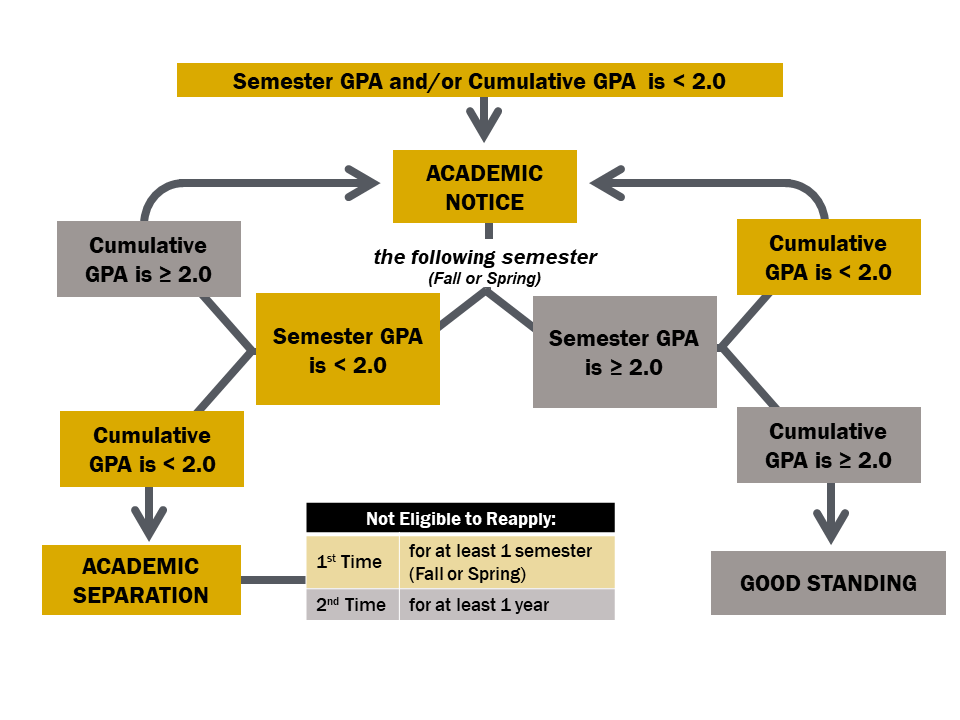
The flowchart is the university-wide policy but certain departments and programs do have other academic notice categories.
Keep in mind the more credit hours a course is worth, the more weight it carries in your GPA. If ever nervous about your GPA plug it into the GPA calculator on Purdue’s Academic Success Center website. See, not as scary.
#3 Maybe this major is not for you
Within an hour of seeing my parents for the first time since they dropped me off at Purdue I told them, “I want to switch my major.” Purdue engineering is not for everyone and I was no exception. I didn’t enjoy any of my first-year engineering courses and struggled. Then it hit me: I have to do this for another four years. At that point I began my path to switch my major.
If you are thinking, maybe this major isn’t for you then Purdue has just the thing for you: a Change of Career Objective, or CODO for short.
Each CODO has unique requirements depending on the major you want to switch into. For economics I had to maintain a certain level GPA and take certain classes as prerequisites. To find out more, you should go to the page on Purdue’s website dedicated for the major you want to switch into and somewhere on there should be a link taking you to the CODO requirements of that major.
Whatever happens academically this coming year, keep in mind you are a Boilermaker and there are so many ways for you to succeed: all you have to do is ask for help.
Comments ()